The Pannonian Sea: The Ancient Ocean That Once Covered Central Europe
The Pannonian Sea
The Ancient Ocean That Once Covered Central Europe

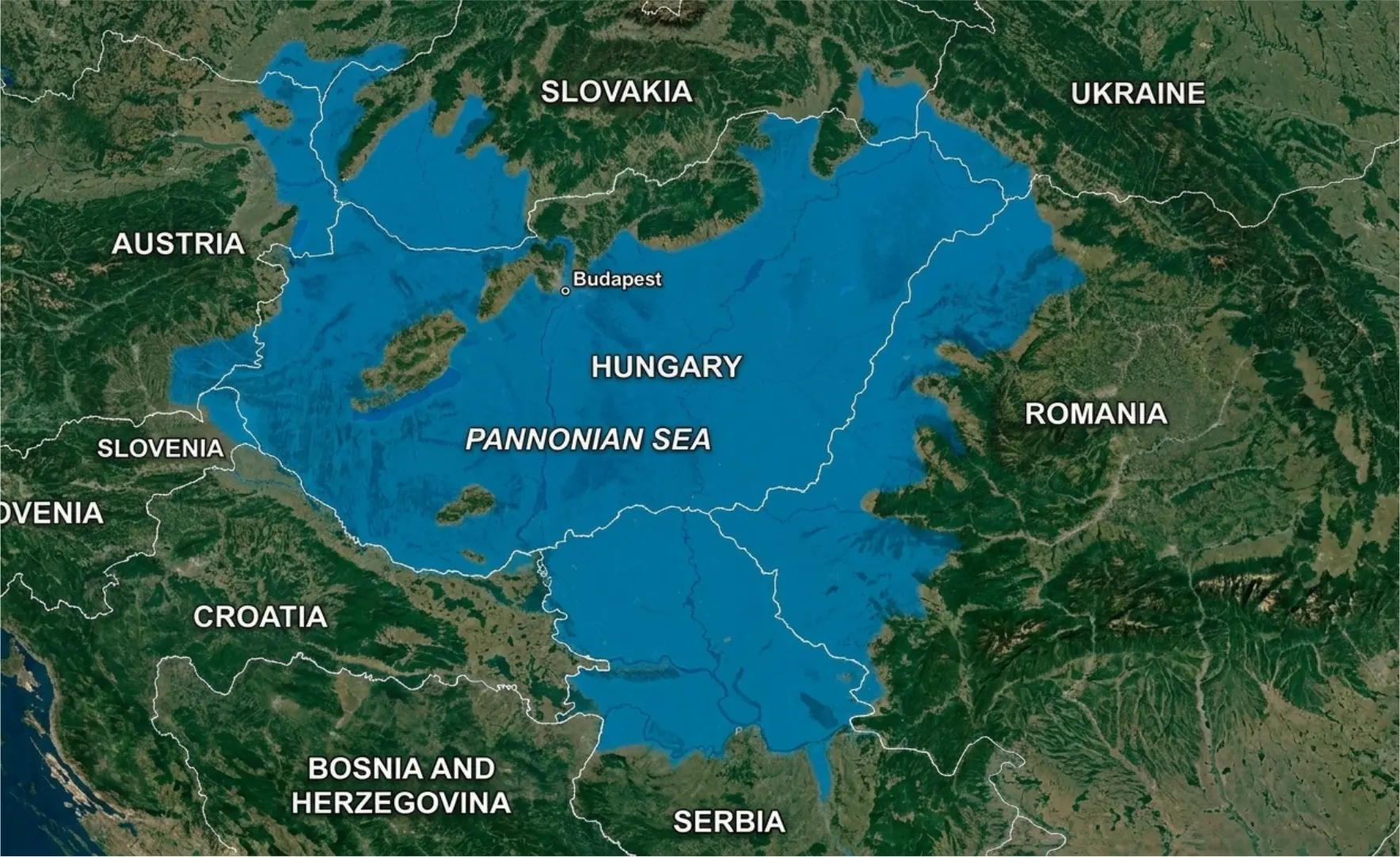
Ten million years ago, Hungary did not exist. Neither did Serbia, Croatia, Austria, or Romania — not as land, anyway. Where these countries stand today, there was water. A vast, shallow inland sea stretching roughly 600 kilometres east to west, teeming with life found nowhere else on Earth. It was called the Pannonian Sea, and for nine million years, it was one of the most remarkable bodies of water on the planet.
Today, the Great Hungarian Plain — one of Europe’s flattest landscapes — sits exactly where that sea once lay. The flatness itself is the clue. It is the dried floor of an ancient ocean.
Born from a Collapsing Continent
The story of the Pannonian Sea begins with the Carpathian Mountains. Around 20 million years ago, during the Miocene epoch, tectonic plates were on the move. As the Carpathian arc pushed northward and eastward, the crust behind it stretched and thinned through a process called back-arc extension. The land sagged. A vast depression opened across Central Europe, and water — drawn from the great Paratethys Sea that once stretched from the Alps to Central Asia — poured in.
At its peak, the Pannonian Sea covered an area comparable to the modern Caspian Sea: roughly 200,000 square kilometres of shallow, warm, brackish water. It spread across what is now Hungary, Serbia, Croatia, Romania, Slovakia, Austria, Slovenia, Bosnia, and parts of Ukraine and Poland. Marine sediments up to four kilometres thick were laid down across this basin — sediments that today sit silently beneath the flat plains of Central Europe.
Cut Off and Slowly Dying
The sea’s fate was sealed around 10 million years ago. The continued uplift of the Carpathian Mountains finally severed the Pannonian Sea’s connection to the wider Paratethys. Cut off from its source, the sea began a slow, multi-million-year process of transformation.
First it turned brackish. Then, as river inflow continued but evaporation and sedimentation steadily reduced its volume, it freshened entirely. What had been a sea became a lake. What had been a lake became a swamp. What had been a swamp became dry land. The entire process took roughly nine million years — a geological blink, but an eternity by human standards.
The sea vanished completely around 600,000 years ago, right around the time the earliest members of our own genus were beginning to walk across Africa.
A World of Unique Life
The isolation of the Pannonian Sea created something extraordinary: a laboratory for evolution. Cut off from the global ocean, species that entered the sea when it was still connected to the Paratethys could no longer interbreed with their cousins elsewhere. Over millions of years, they diverged. Entirely new species — found nowhere else on Earth — evolved within its waters.
Palaeontologists have recovered fossils of endemic molluscs, fish, and other marine creatures unique to the Pannonian basin. The diversity and strangeness of this fauna reflects just how long the sea existed in isolation — long enough for evolution to take the creatures within it in entirely new directions.
What It Left Behind
The Pannonian Sea did not disappear without a trace. It left behind an entire landscape and a remarkable geological inheritance.
The flatness of the Hungarian Plain — the Alföld — is the dried floor of the sea. The rich sedimentary layers beneath it have made the Pannonian Basin one of Central Europe’s most significant sources of oil, natural gas, and lignite coal. The hydrocarbons that powered 20th-century industry in Hungary, Romania, and Serbia were formed from the organic remains of Pannonian marine life, compressed over millions of years beneath kilometres of sediment.
Even the lakes remain. Lake Balaton in Hungary — Central Europe’s largest lake — is a direct descendant of the Pannonian Sea, a fragment that never fully dried. Lake Neusiedl on the Austrian-Hungarian border and Lake Palić in Serbia are further survivors, relics of a vanished ocean preserved in modern geography.
Key Facts
| Age | ~10 million to 600,000 years ago (Late Miocene to Pleistocene) |
| Size | ~200,000 km² at peak extent |
| Depth | Shallow — never exceeded ~1,000 metres |
| Location | Modern Hungary, Serbia, Croatia, Romania, Slovakia, Austria, Slovenia |
| Cause of formation | Back-arc extension behind the Carpathian mountain arc |
| Cause of disappearance | Carpathian uplift cut off connection to Paratethys; gradual infilling and evaporation |
| Legacy today | Hungarian Plain, Lake Balaton, oil and gas deposits, endemic fossil fauna |
Sources & Further Reading
- Magyar, I., Geary, D.H. & Müller, P. (1999). Paleogeographic evolution of the Late Miocene Lake Pannon in Central Europe. Palaeogeography, Palaeoclimatology, Palaeoecology — ScienceDirect
- Krijgsman, W. et al. (2012). The isolation of the Pannonian basin (Central Paratethys): New constraints from magnetostratigraphy and biostratigraphy. Global and Planetary Change — ScienceDirect
- Harzhauser, M. & Piller, W.E. (2004). Ancient Lake Pannon and its endemic molluscan fauna. Developments in Palaeontology and Stratigraphy — ScienceDirect
- Mezger, E.M. et al. (2023). Seawater sulphate heritage governed early Late Miocene methane consumption in the long-lived Lake Pannon. Communications Earth & Environment — Nature.com
- Mandic, O. et al. (2011). Paleogeographic evolution of the Southern Pannonian Basin: age constraints on the Miocene continental series of Northern Croatia. International Journal of Earth Sciences — Springer
Explore more vanished worlds in the Lost Seas & Oceans archive, or download the free sample chapter of The Lost Atlas to read about Earth’s ancient supercontinents.